Notes on Canonical Triangulations of Two-Bridge Link Complements
10.05.2026Complements of two-bridge links in \(S^3\) form a family of hyperbolic 3-manifolds which admit nice decompositions into ideal tetrahedra. Their canonical triangulation, usually called the Sakuma-Weeks triangulation, is shown to be geometric by Futer here. Purcell gives an exposition similar to Futer's here. These notes take a different approach, which happens to be similar to the one Nimershiem gives in the appendix to her paper here.
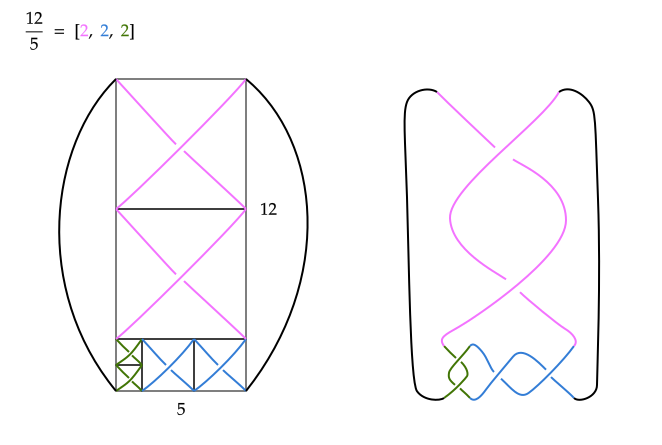
We will go by example, triangulating the link associated to the rational number 12/5:
The goal is to triangulate the complement. Let's first split the space up into blocks. Set a collection of nested spheres starting at the inner-most crossing and growing outwards one crossing at a time (you can ignore the final crossing for now). I'll draw these as blue squares and label them from 1 to 5. If you open up these spheres, you can redraw the link as on the right:
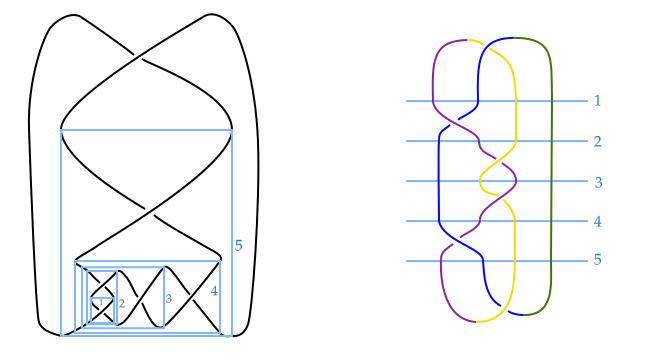
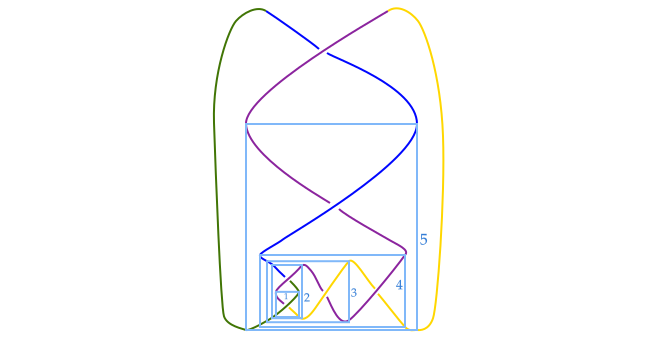
Between spheres 1 and 5, we get a braid diagram. Instead of closing off the braid in the usual way, however, we clasp the top and bottom. Here is a coloring of the original link diagram to match the coloring of the strands above:
Now we'll use these sphere to break up the manifold into blocks of four-punctured spheres cross \(I\). We will see that we just need the blocks bounded by 2 and 3, 3 and 4, and 4 and 5. In the following picture, we view the blue edges (which before represented spheres) as edges between strands of the link. We'll also introduce two new edges per sphere — these are decorative and will help us keep track of gluing information later.
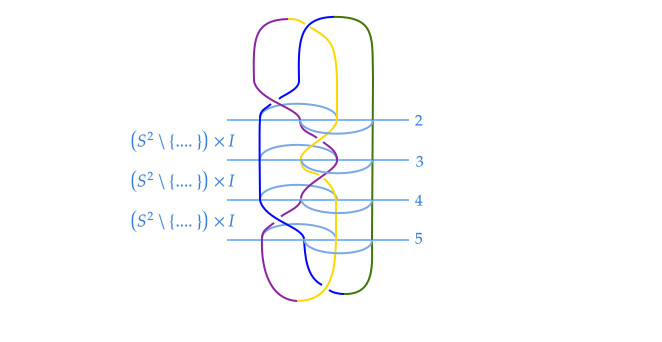
Stripping away the clasps on the top and bottom, we'll look at these blocks, which are copies of \(S^2\setminus\{....\}\times I\), as Lego blocks stacking together to build up our space.
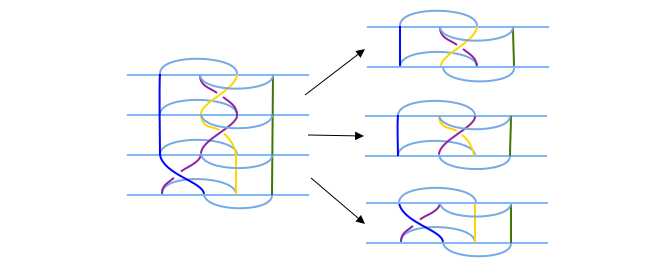
We can straighten these blocks out to look friendlier. First, take a block and imagine fixing the top sphere. Now take the strands of the link and undo the crossing, making sure to carry the edge information on the bottom sphere:

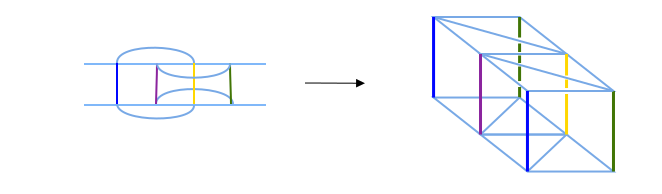
From here, we'll cut open the sphere block to make it easier to look at. First imagine that you are standing in front of the block and your friend is standing behind it. You each put one hand on the blue strand and one hand on the green strand, and you pull them towards yourselves, keeping the purple and yellow strands fixed in place. The blue and green strands will each break into two, and three faces will become unglued, but you end up with a nice pair of cubes, as shown on the right of the following picture. We'll use this block picture going forward, keeping in mind that the left two walls are glued to each other, the right two walls are glued to each other, and the front and back walls are glued to each other.
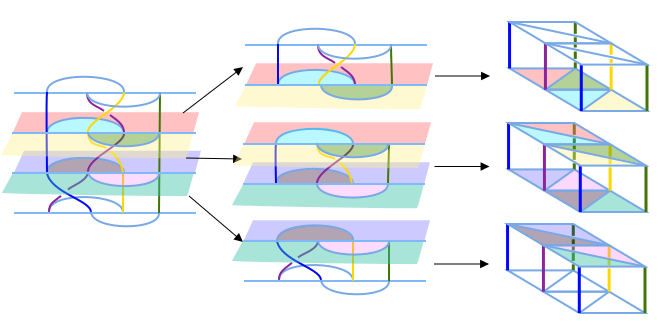
Okay, so now that we know what the building blocks are, we need to understand how to glue them together. Remember we have three of these blocks that we need to glue together. For all but the very top and very bottom faces, it's pretty simple: the gluing comes exactly from the stacking. Here is a picture coloring the faces of the spheres and showing how that translates into gluings of the blocks:
Now we need to find a gluing of the top-most sphere which clasps off the top of the braid. The following shows a gluing which translates to the purple strand connecting to the yellow strand and the blue strand connecting to the green strand while creating two crossings, the combinatorial effect desired by the link diagram. The gluing happens by folding each pair of faces over their common edge (recall the front wall is glued to the back wall, so the green faces fold over the front/back edge).
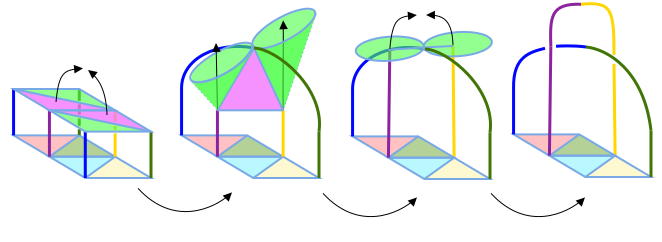
Something very similar gives the gluing of the bottom clasp. If one moves the top of the green strand to the right of the yellow strand in the following picture, then one crossing is created, as desired by the link diagram.
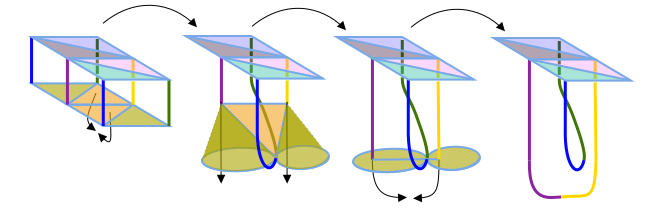
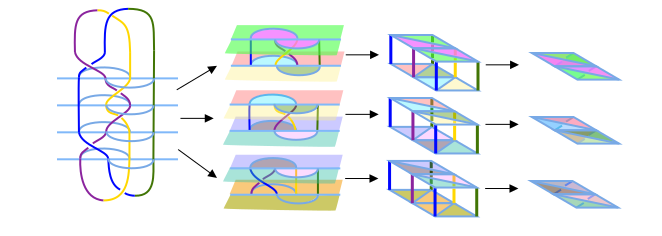
Now we have these blocks and how they all glue together to give the knot complement. The last thing to do is to say how these blocks correspond to tetrahedra. Well, since each wall of each block has a neighborhood homeomorphic to a ball, and because the top and bottom edge of each wall are isotopic, then we can crush each wall by moving the top and bottom edges together. Thus from each cube we get a tetrahedron. You'll notice that it's hard to see the gluings in the tetrahedra picture, so it is sometimes more useful to think about blocks. In all, the pipeline looks like:
I've written code to build these triangulations (as Regina or SnapPy objects) here.