04.04.2026
The connection between rational numbers, continued fraction expansions, and two-bridge links didn't hit me until I had been playing around with them for a while. I'm sure this way of exposition is well-known, but the sources that I was reading had other motives (usually triangulating their complements), so avoided this. In any case, when I was playing around with these links, I had a big aha moment followed quickly by a "why didn't anyone explain it to me like this?" moment. I couldn't find this explanation anywhere else, although I know it must exist, so I'm writing it here.
We'll go by example, since the general case is similar. Start with a rational number; say, \(17/5\). You can compute its continued fraction expansion via the Euclidean algorithm: \begin{align*} 17 &= 5 \cdot \color{magenta} 3 \color{black} + 2\\ 5 &= 2 \cdot \color{blue} 2 \color{black} + 1\\ 2 &= 1 \cdot \color{green} 2 \color{black} + 0. \end{align*}
We'll write \(17/5 = [\color{magenta} 3 \color{black}, \color{blue} 2 \color{black}, \color{green} 2 \color{black}] \) to mean that $$ \frac{17}{5} = \color{magenta} 3 \color{black} + \frac{1}{\color{blue} 2 \color{black}+\frac{1}{\color{green} 2 \color{black}}}. $$
All in one go, we'll give a geometric interpretation of the continued fraction expansion and define the two-bridge link associated
to it. Let's call the following a strand block:
We'll read the continued fraction expansion \([\color{magenta} 3 \color{black}, \color{blue} 2 \color{black}, \color{green} 2 \color{black}]\) backwards. So to begin, stack \(\color{green} 2 \color{black}\) strand blocks on top of each other:

Then, lay \(\color{blue} 2 \color{black}\) strand blocks to the right. The side lengths of the new strand blocks should be
the height of the result of the previous step:

Then, stack \(\color{magenta} 3 \color{black}\) strand blocks on the top, ensuring the side length of each new block is the
entire width of the result of the previous step:
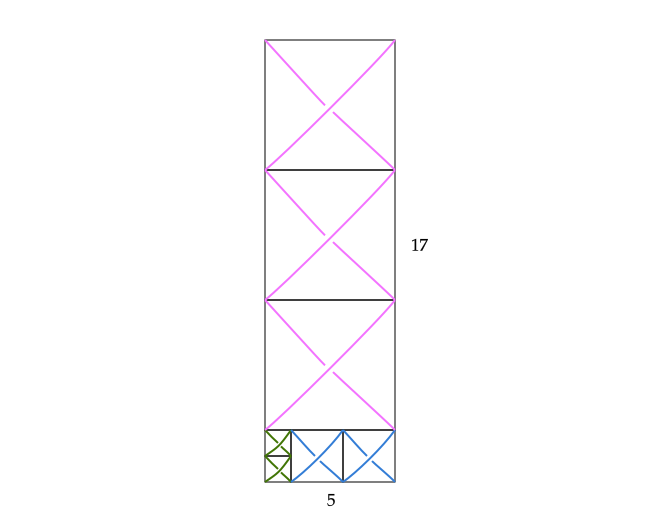
Now, if the first strand block we placed has unit length, then our original fraction \(17/5\) is the ratio of the side lengths
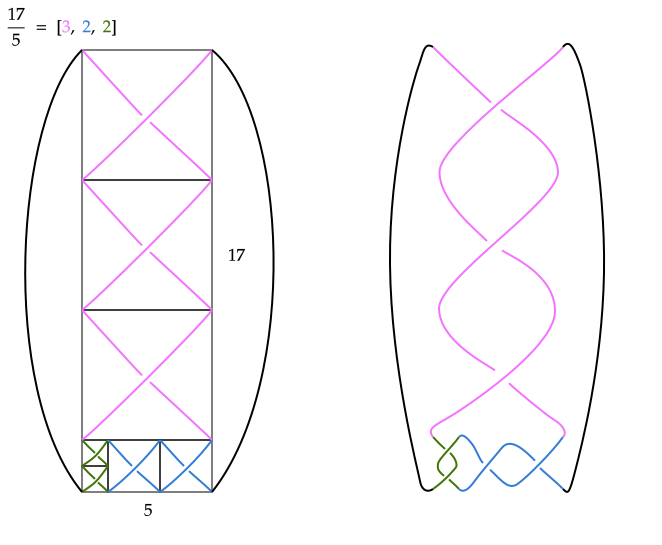
of our final stack of blocks! To get the associated link, just remove the squares and close up the strands by dropping two new
strands down parallel to the left and right edges of the stack of blocks: