![[3,3] link with two edges colored differently](images/3-3-link.svg)
25.05.2026
This is a calculation that I wanted typed up. The goal is to use veering triangulations to show that the rational link given by the continued fraction expansion \([3,3]\) is a four-punctured sphere bundle, and to calculate its monodromy.
Start with the Sakuma-Weeks triangulation of the link \(K([3,3])\), and perform a 3-2 move on the red edge and a 3-2 move on the teal edge. Each edge is shown twice, and it can be easily checked that the two red edges are isotopic and the the two teal edges are isotopic, and they're both of degree three.
The resulting triangulation has four tetrahedra with gluings tabulated below. It has isomorphism signature eLMkbcddddedde.
| Tetrahedron | Face 012 | Face 013 | Face 023 | Face 123 |
|---|---|---|---|---|
| 0 | 2 (013) | 1 (031) | 2 (021) | 1 (132) |
| 1 | 3 (021) | 0 (031) | 3 (032) | 0 (132) |
| 2 | 0 (032) | 0 (012) | 3 (013) | 3 (132) |
| 3 | 1 (021) | 2 (023) | 1 (032) | 2 (132) |
Using the veering library, we can see that this triangulation has a transverse veering structure. This is can be accessed with the decorated isosig eLMkbcddddedde_2100. We can draw the veering structure as follows, where the transverse direction is always upwards.
![[3,3] link triangulation with veering structure](images/3-3-veering.svg)
The large labels are the tetrahedron labelings and the small labels are the model vertices. Carefully looking at the edge identifications shows that there is a layering, where groups of four faces form a four-punctured sphere (for example, the faces 0(012), 0(123), 3(123), 3(013) form a four-punctured sphere which is carried upwards by the veering structure).
![[3,3] link triangulation with layering structure](images/3-3-layered.svg)
Now we need to understand how these four-punctured spheres glue together in order to understand the monodromy of this bundle. Let \(\Sigma_{0,4}\) be the four-punctured sphere and recall that the mapping class group \(\text{Mod}(\Sigma_{0,4}) \cong \text{PSL}_2(\mathbb Z) \ltimes (\mathbb Z/2\mathbb Z \times \mathbb Z/2\mathbb Z)\). This comes from lifting a homeomorphism of \(\Sigma_{0,4}\) to the torus via the hyperelliptic involution of the torus.
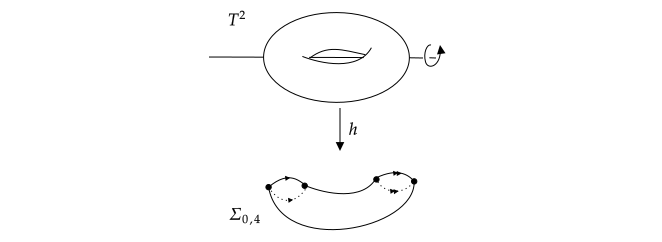
The maps on \(\Sigma_{0,4}\) not seen by the mapping classes of the torus are generated by rotations by \(\pi\) in the factors of \(T^2 = S^1\times S^1\). We will call these \(i_1\) and \(i_2\).
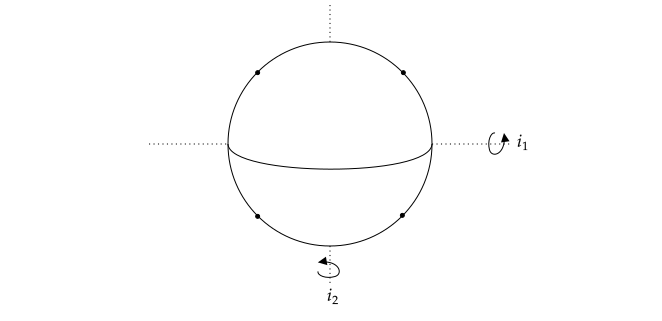
We will now look at how triangulations of \(\Sigma_{0,4}\) are affected by certain generators of \(\text{Mod}(\Sigma_{0,4})\). In the following pictures, we start with a triangulation of a four-punctured sphere and perform homeomorphisms to the sphere to see what happens to the triangulation. The arrows exist to keep track of the orientation of each face.
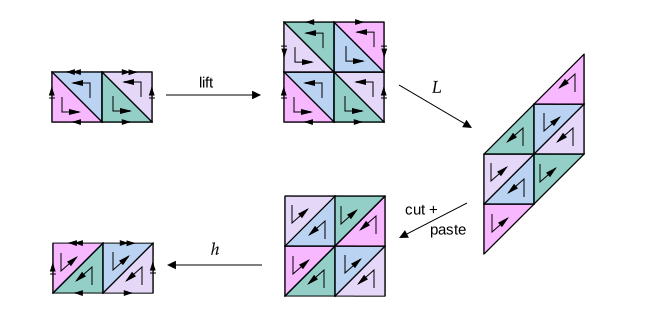
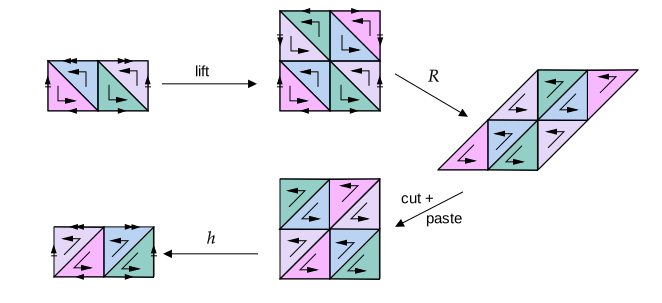


Now with a little bit of effort, we can see that the gluings of the triangulation use an \(L\) and a \(R\circ i_1\). So we get a monodromy \(L \circ R \circ i_1\).
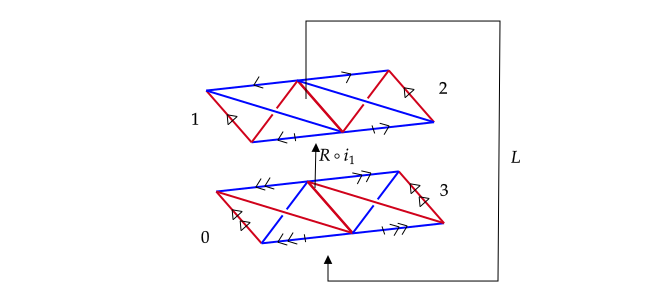
It's worth trying to visualize this monodromy as a braid. We will look at the mapping cylinders of \(L\), \(R\), and \(i_1\). In the following pictures, the inner sphere is triangulated in such a way that the colors of the arrows on the faces match the colors of the faces in the previous triangulation pictures. The purple strands are the boundary components.
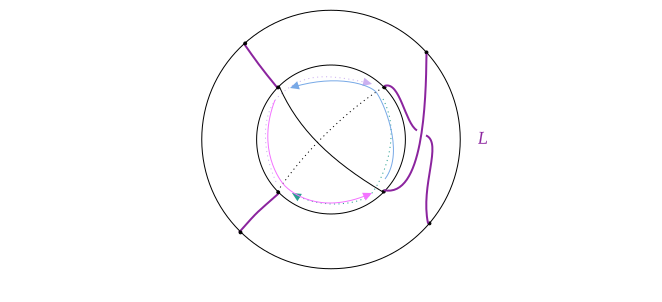
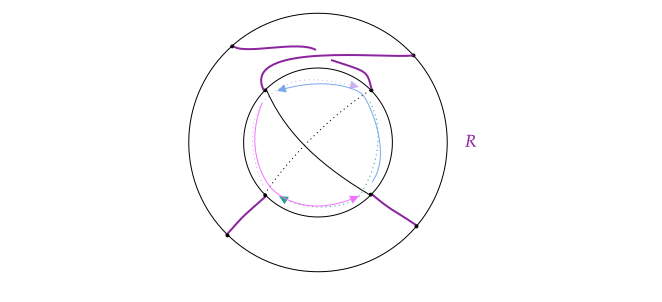
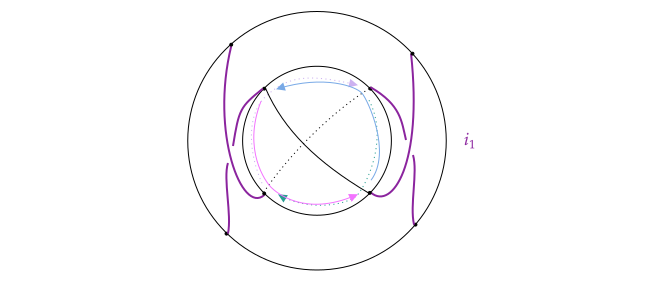
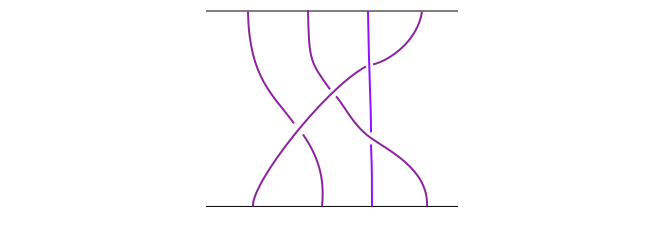
Putting these together, we get the following braid.
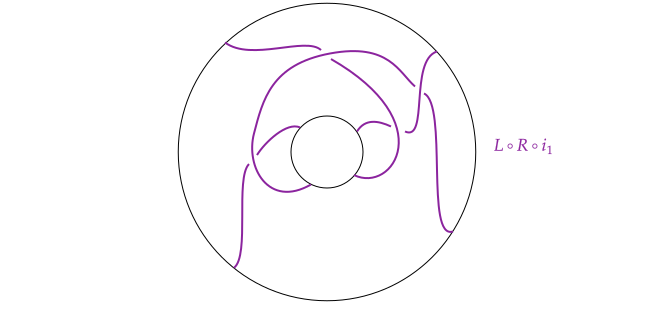
Redrawing the above picture by flattening out the spheres, we get the following picture. Gluing the top sphere to the bottom sphere
to get a link in \(S^2\times S^1\) recovers the two-bridge link in \(S^3\).