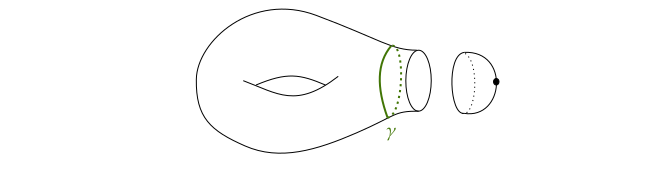
Here's an interesting side quest I went on last semester. When learning about surfaces, one learns quickly that the mapping class group of the torus is isomorphic to \(SL_2(\mathbb{Z})\). The argument can be applied almost identically to the once-punctured torus \(S_{1,1}\) to get that \(\text{Mod}(S_{1,1}) \cong SL_2(\mathbb{Z})\). From here, one calculates the mapping class group \(\text{Mod}(S^1_1)\) of the torus with one boundary component by studying the capping homomorphism, the effect of capping off a boundary component as pictured above. This trivializes the Dehn twist about the illustrated curve \(\gamma\), giving us the following commutative diagram:
Here, we are using the presentation \(SL_2(\mathbb Z) \cong \langle a,b\,|\, aba = bab, (ab)^6 = 1 \rangle\). The group \(\widetilde{SL_2(\mathbb Z)} \cong \langle a,b \,|\, aba = bab \rangle\) is the universal central extension of \(SL_2(\mathbb Z)\) (I guess one should think of 'lifting' the relation \((ab)^6 = 1\)). The homomorphism sends the Dehn twists around the meridian and longitude to \(a\) and \(b\). The five lemma then gives that \(\text{Mod}(S_1^1)\cong\widetilde{SL_2(\mathbb Z)}\).
Looking at the commutative diagram above, one is left to wonder what the connection between the (very simple) curve \(\gamma\) and the 6-torsion in \(SL_2(\mathbb Z)\) is. Six is a weird number, after all, and \(SL_2(\mathbb Z)\) is such a natural group to think about — it's central to undergrad linear algebra courses. Wait, why is there 6-torsion in \(SL_2(\mathbb Z)\), and why does it show up in such a nice presentation of the group?
An uninspired answer would be this: just do the matrix multiplication. The presentation comes from \(a=\begin{pmatrix} 1 & -1 \\ 0 & 1 \end{pmatrix}\) and \(b = \begin{pmatrix}1 & 0 \\ 1 & 1\end{pmatrix}\). So we get $$ \left(\begin{pmatrix} 1 & -1 \\ 0 & 1 \end{pmatrix}\begin{pmatrix}1 & 0 \\ 1 & 1\end{pmatrix}\right)^6 = 1.$$ But this is, perhaps, no more than numerical coincidence. So the question becomes:
Question: Is there geometric intuition for the relation \((ab)^6 = 1\)?
I'm going to give three answers, but I need to work on making shorter posts because otherwise I never finish them. So I'm splitting this up into three parts, and the first part is below.
The first thing to try is understanding the usual action of \(ab\) on the plane via the linear transformation \(\begin{pmatrix}0 & -1 \\ 1 & 1\end{pmatrix}\). But this is not so enlightening (try it).
Our goal will be to perform a change of basis to make the action of \(ab\) more familiar. The motivation comes from thinking about where else six shows up: the hexagonal torus.
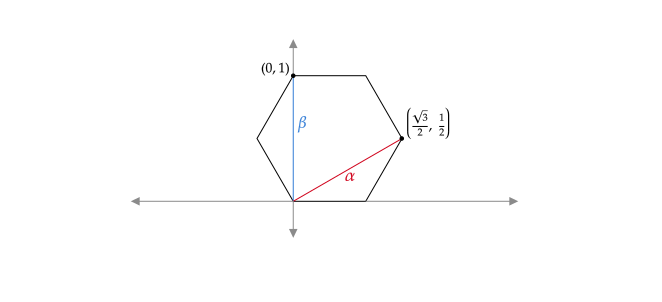
The usual action of \(ab\) comes from seeing \(a\) and \(b\) as Dehn twists about the curves represented by the standard basis vectors
in \(\mathbb R^2\). We will change the basis to correspond to the above curves \(\alpha\) and \(\beta\):