or: two theorems, both alike in dignity
07.02.2026This week, in reading two very different things (well, both about surfaces I guess), I came across two theorems in different areas but with the same theme. As I read more and more topics in math, I want to compare the development of different ideas. \(^1\) Anyways, the theme here is that we have some space which parametrizes the objects we care about. Typically we can coordinatize it in some way by measuring features of the object. The simple analogy is determining a point of \(\mathbb R^2\) by getting its polar coordinates \(p=(r,\theta)\). Here, I need to measure length and angle. But if my grad student stipend allows only the purchase of either a ruler or a compass, can I determine \(p\) with just one tool? The answer here is of course yes — I should buy the ruler and measure the \(x\) and \(y\) coordinates.\(^2\) To rephrase the question, can I perform a change of coordinates so that I just have to measure one type of thing?
The first theorem comes from Teichmuller theory. The narrative is you have a surface \(S_g\) of genus g and you'd like to parametrize all possible hyperbolic metrics on that surface, i.e. you want to find the Teichmuller space of \(S_g\). There's a nice way to do this: using \(3g-3\) curves, cut your surface up into pairs of pants. The hyperbolic metrics on a pair of pants are totally determined by the lengths of the three boundary components.\(^3\) So if you specify the lengths of your \(3g-3\) curves in the pair-of-pants decomposition, then you've almost determined the hyperbolic metric. But when gluing the pants together, you can twist one of the pants by some angle (and even though the isometry type is determined mod \(2\pi\), twisting multiple times will give different isotopy classes of images of curves, and so these are considered different points in Teichmuller space). So to determine the metric on your surface, you need to measure \(3g-3\) curves and, for each of those curves, measure the \(3g-3\) twist parameters. Indeed, \(\text{Teich}(S_g) \cong \mathbb R^{6g-6}\).
Suppose, however, that Curve Mart has just run out of twistparameterometers (not that you could afford one anyway) and so you and your rusty but reliable hyperbolic ruler are left wondering what metric your surface has. Is there some set of curves on your surface whose lengths, if known, could tell you what point in \(\text{Teich}(S_g)\) you have? \(^4\)
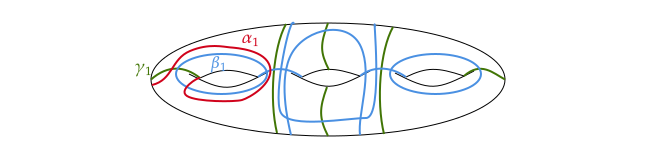
Since you can measure the lengths of the curves of the pair-of-pants decomposition, all you need to do is find a way to measure the twist parameters. Let \(\gamma_1,\dots,\gamma_{3g-3}\) be the pair-of-pants decomposition. The idea is to clamp each \(\gamma_i\) between two curves, where the difference in length between the two curves should tell you something about how the \(\gamma_i\) are twisted. For each \(\gamma_i\), create a \(\beta_i\) which intersects \(\gamma_i\) positively but does not intersect \(\gamma_j\) for \(i\neq j\). Then let \(\alpha_i\) be the curve given by Dehn twisting \(\beta_i\) about \(\gamma_i\). A lazy picture is shown below for most of the curves (only one \(\alpha_i\) is shown and the curves behind the surface are implied). It turns out that these \(9g-9\) curves are all you need to measure.
Theorem. (The \(9g-9\) Theorem) If \(X,Y \in \text{Teich}(S_g)\) and if any of the lengths of the \(9g-9\) curves discussed above in \(X\) are different than those of \(Y\), i.e. \begin{align*} (\ell_X(\gamma_1), \dots, \ell_X(\gamma_{3g-3}), \ell_X(\beta_{1}), \dots ,\ell_X(\beta_{3g-3}), \ell_X(\alpha_{1}), \dots, \ell_X(\alpha_{3g-3}) ) \\\neq (\ell_Y(\gamma_1), \dots, \ell_Y(\gamma_{3g-3}), \ell_Y(\beta_{1}), \dots ,\ell_Y(\beta_{3g-3}), \ell_Y(\alpha_{1}), \dots, \ell_Y(\alpha_{3g-3}) ), \end{align*} then \(X \neq Y\).
The second theorem comes from representation theory. The narrative is that you have a finitely generated group \(\Gamma\) and you have this variety \(R(\Gamma)\) of representations into \(SL_2(\mathbb C)\) which you've built up and cared for and loved so dearly. But there's sort of a defect with it in that it sees two equivalent representations as different things, which is kind of annoying because you care ultimately about the geometric implications, and you're bothered in the same way that having different basepoints bothers you. In any case you try to come up with a tool which blurs together equivalent representations without over-bluring.
The key comes from the nice fact that if \(B\) is a matrix with determinant 1, then \(\text{tr}(BAB^{-1}) = \text{tr}(A)\). Since two representations are equivalent if they differ by an inner automorphism (so by conjugation by a fixed matrix \(B\)), taking the trace of all elements will blur together the equivalent representations. And a nontrivial result stating that the character (the function taking in a matrix and spitting out its trace) is basically a total invariant of representations, gives us that we don't over-blur. The question now is if I have a representation \(\rho \in R(\Gamma)\), is there a finite set of matrices \(\rho(\gamma_1),\dots,\rho(\gamma_n)\) for which I can measure the trace and know exactly what \(\rho\) is?
Before I answer this, I want to emphasize the analogy I'm trying to set up.
It turns out that if \(\Gamma\) is generated by \(g_1,\dots,g_n\), then all we need to measure are the \(2^n - 1\) matrices of the form \(\rho(g_{i_1}\cdots g_{i_k})\) where \(1 \leq i_1 < \cdots < i_k \leq n\). In fanciful terms which I won't bother to introduce here, we get the following theorem from this paper.
Theorem. Suppose that a group \(\Gamma\) is generated by elements \(g_1,\dots,g_n\). Then the trace ring \(T(\Gamma)\) is generated by the elements \(I_W(\rho) = \text{tr}(\rho(W))\) where \(W\) ranges over all elements of the form \(g_{i_1}\cdots g_{i_k}\) as discussed above.
[1] I think abstracting the theme and juxtaposing the corresponding motifs helps solidify, at least in my mind, the narrative that each area is trying to tell. I think I'm trying to shift away from the Definition-Theorem-Proof way of understanding topics in math and trying instead to get the "narrative" of the topic. After all, math is created because someone wanted to understand something. And that desire drove them to do something. And that something is what I want to capture in some sense. This is probably a nonsensical footnote but it's already written so I won't bother deleting it.
[2] This is assuming I get for free the \(x\)- and \(y\)-axes and can measure coordinate projections without the need of a compass.
[3] This fact involves some nice and simple hyperbolic geometry. It boils down to a rigidity of hyperbolic hexagons. In A Primer on Mapping Class Groups, Farb and Margalit emphasize that one should expect a space of metrics to be infinite dimensional, but Teichmuller space has dimension \(6g-6\). So one is invited to philosophize about how the rigidity of hexagons significantly cuts the space of metrics.
[4] Of course, you could measure the geodesic between every pair of points, but we're after some reasonable, finite solution.