28.02.2026
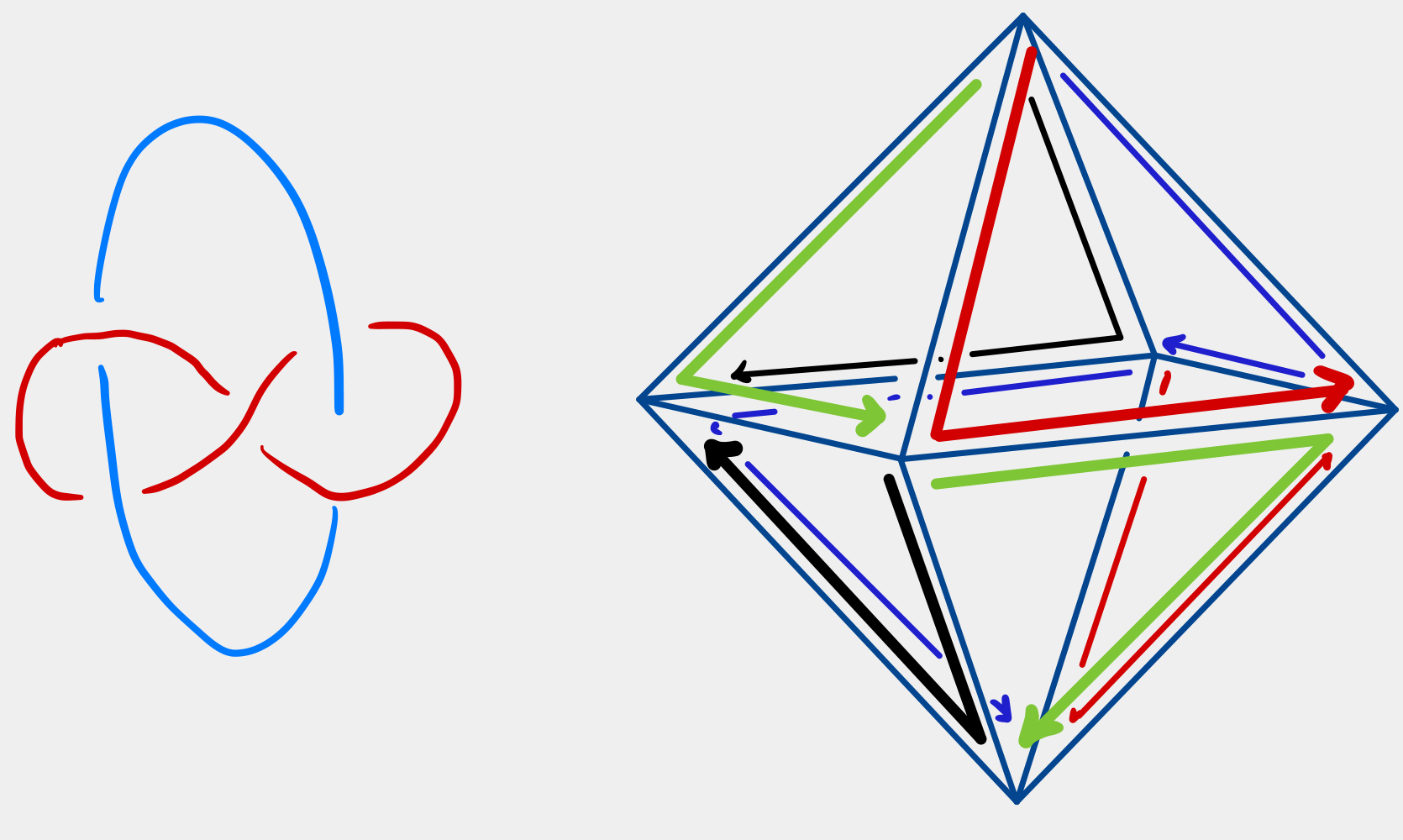
The canonical decomposition of the Whitehead link is a regular octahedron:
This is a nice decomposition, but it's useful to break it into tetrahedra. In doing so, you can say some interesting things about triangulations of the Whitehead link.
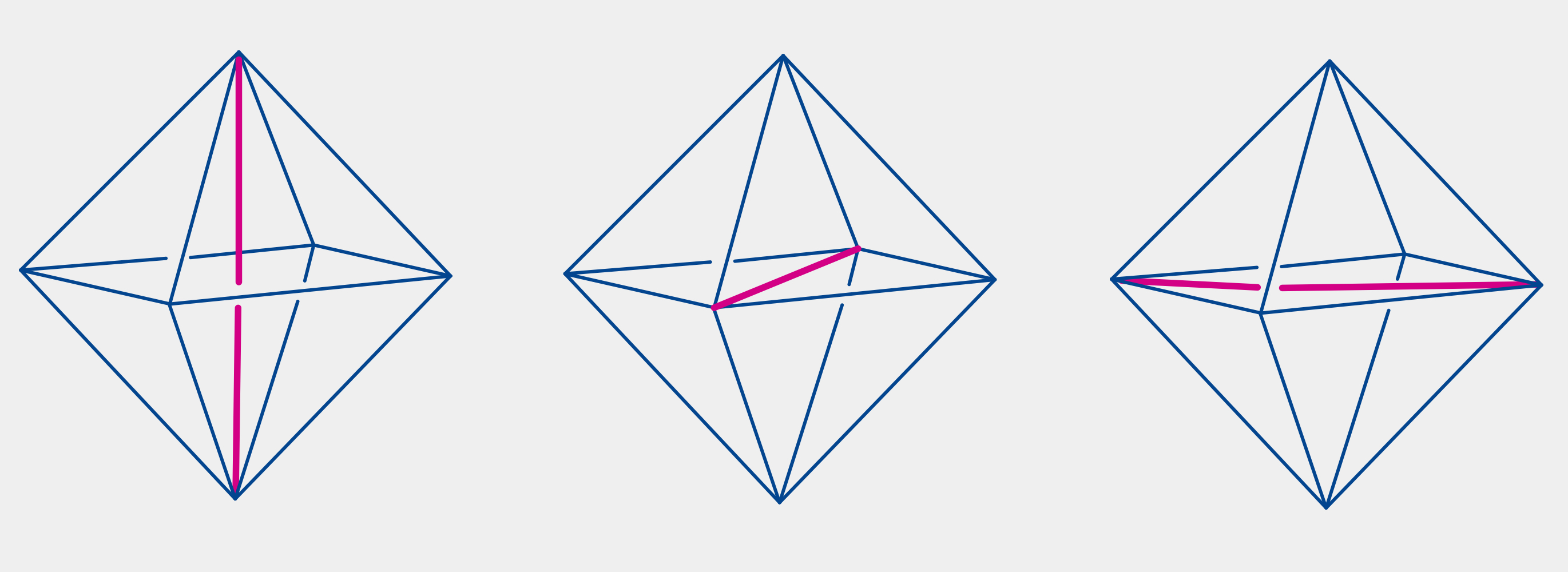
Firstly, if you want to minimally cut up an octahedron into tetrahedra while fixing the vertices, you have exactly three ways to do it. Each corresponds to a choice of diagonal (magenta in the picture below).
Doing this with the Whitehead link's face identifications happens to yield all non-isomorphic four-tetrahedra triangulations of the manifold. Here they are, labeled with their isomorphism signature:
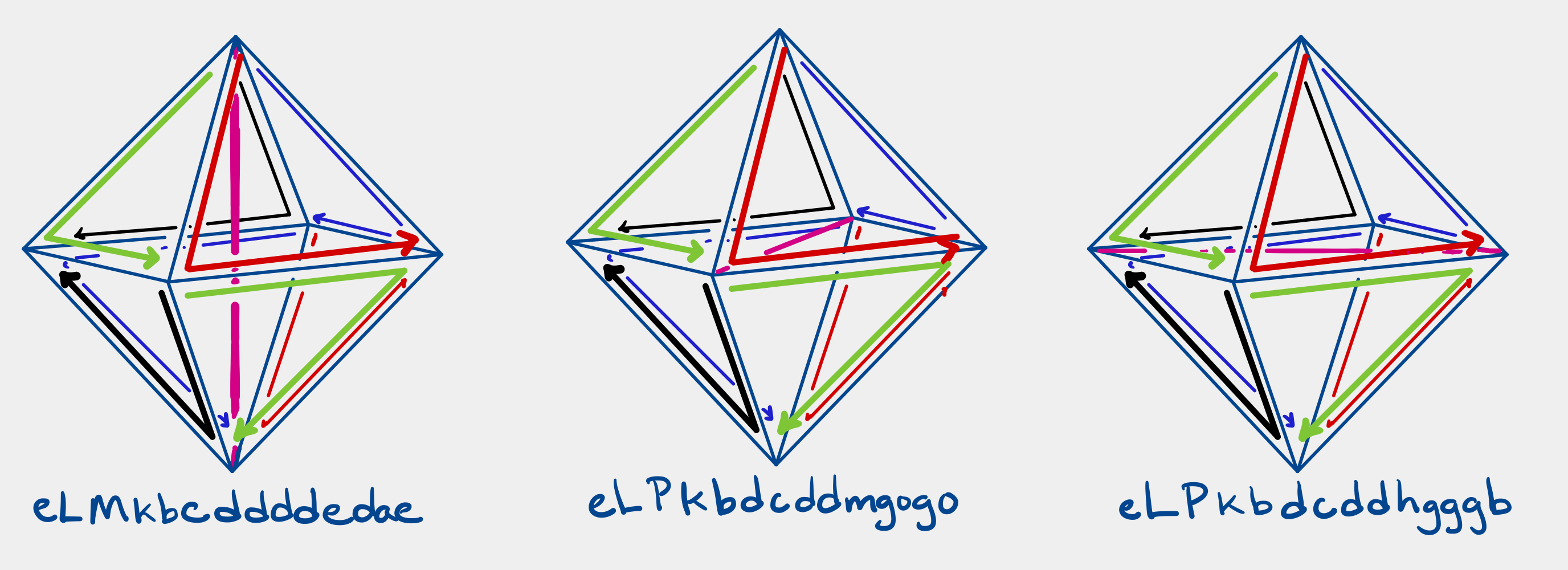
These three triangulations are geometric and minimal. So this is a very nice example of the fact that a minimal triangulation is not necessarily unique, even if you restrict to geometric triangulations. Now, to get from one triangulation of an octahedron to another, you can do what's called a 4-4 move. This is a combination of a 2-3 move followed by a 3-2 move:
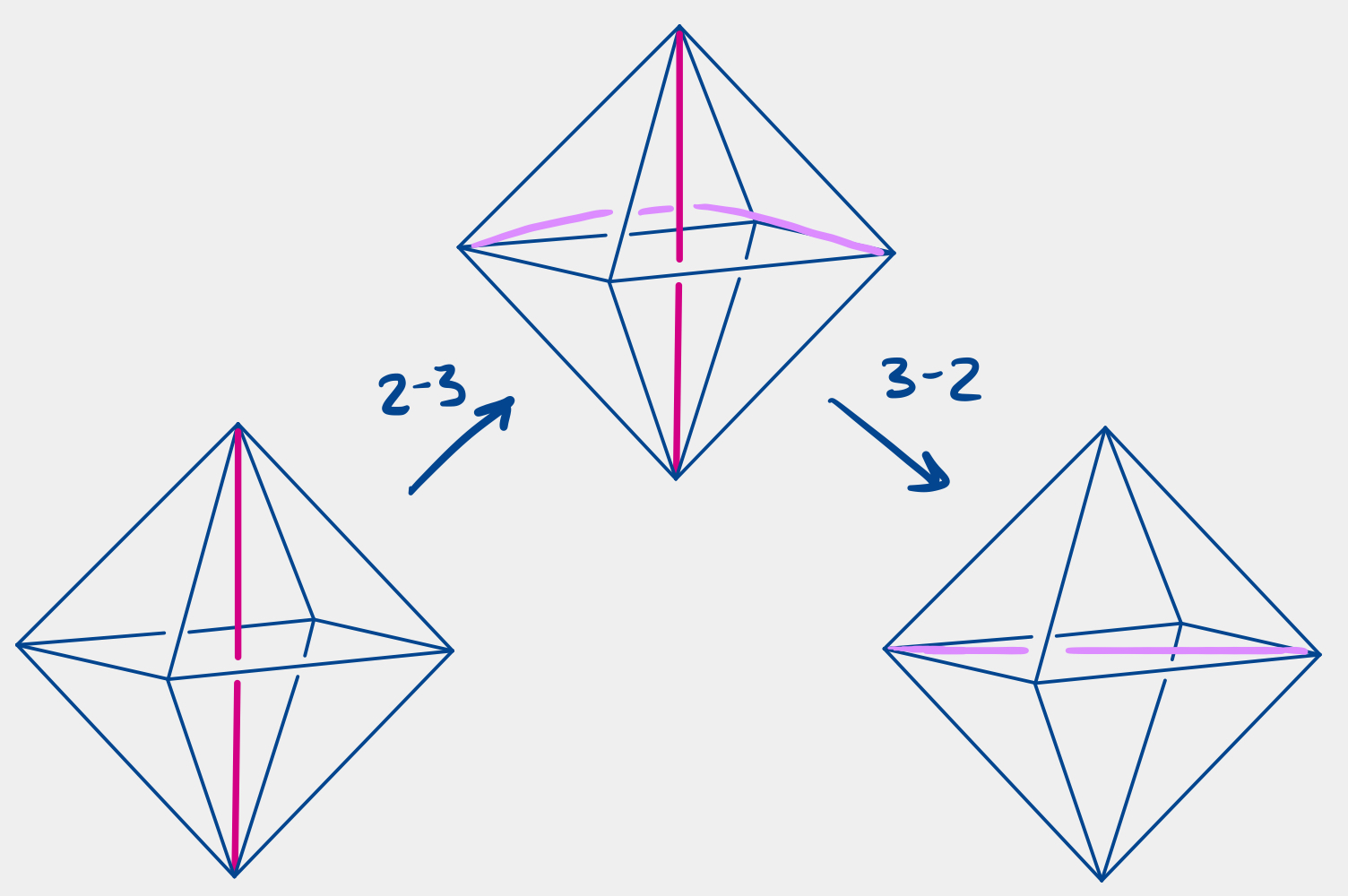
In the case of the Whitehead link, the intermediate triangulation has a flat tetrahedron. Here is the interesting thing: two of the three triangulations of the Whitehead link (eLMkbcddddedae and eLPkbdcddmgogo) have a recursion gadget in the sense of Dadd and Duan. In other words, you can perform 2-3 moves on these two triangulations to get geometric triangulations with arbitrarily many tetrahedra. However, the triangulation eLPkbdcddhgggb has no such gadget and is in fact isolated geometric in the sense that I describe here.
